A QUESTION, A BAMBOO STICK, A VERSE
What Are Chinese Fortune Sticks?
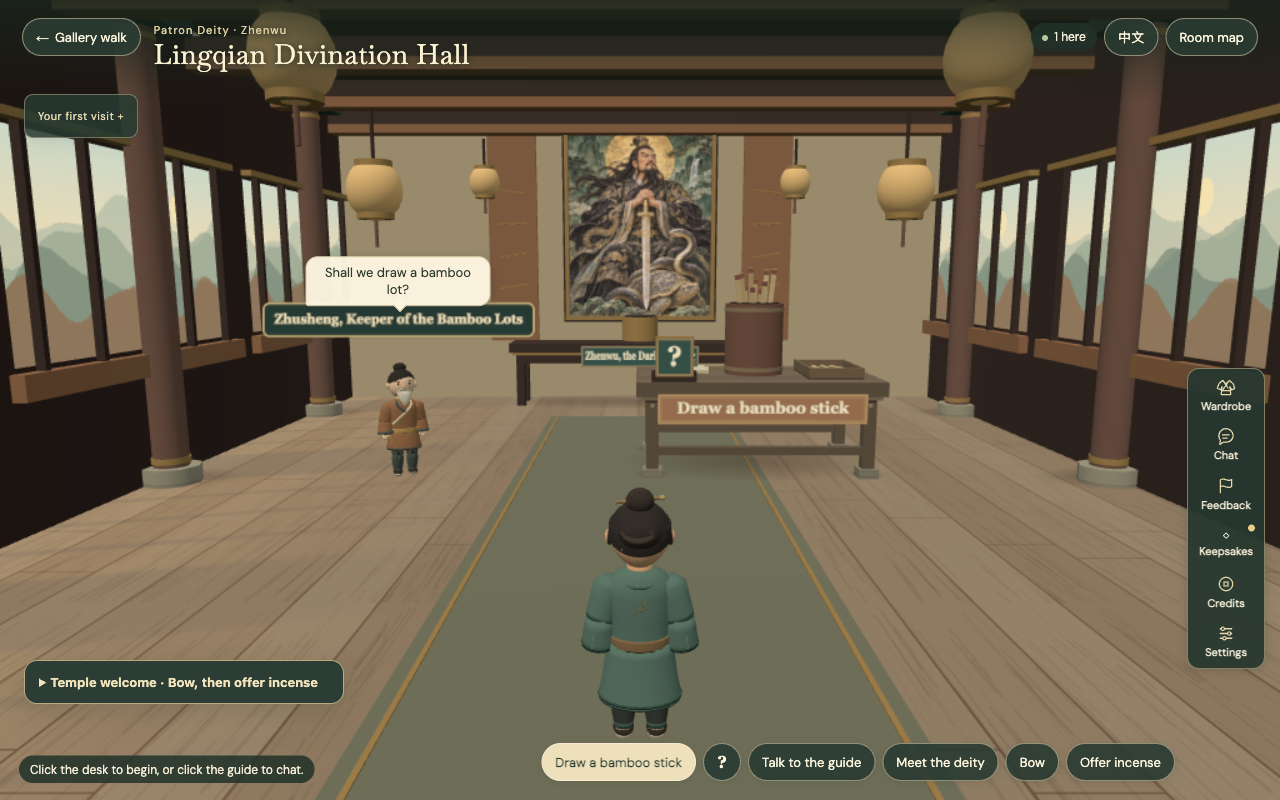
A cylinder of slender bamboo sticks. One question held in mind. A number that leads to a poem. Chinese fortune sticks offer a striking way to pause over something that matters to you. At Pinecourt, you can explore that form through twelve original verses, with English and Chinese readings.
What does lingqian mean?
Lingqian (灵签) is a Chinese term for divinatory lots, often called fortune sticks in English. In a temple setting, a numbered stick corresponds to a verse in that temple’s collection. The National Museum of Taiwan History preserves both bamboo sticks with numbers and printed temple poems, showing the objects behind the practice.
Collections differ. A number only makes sense within its own set: lot seven at one temple need not have the same poem as lot seven somewhere else. Read the collection’s name as well as the number when exploring an unfamiliar set.
Cultural references: National Museum of Taiwan History · Bamboo cylinder and numbered lots · National Museum of Taiwan History · Printed lot 79, Yilan City God Temple
What happens when I draw one here?
In Pinecourt’s Lingqian Divination Hall, choose a topic and select “Shake the bamboo sticks.” One of twelve equally likely sticks is drawn. Its title, verse and reading appear at the desk, along with a small suggestion connected to your topic.
All twelve verses and their everyday readings were written for Pinecourt. They are original creative work, rather than quotations from an ancient scripture or a reproduction of a particular temple’s oracle. The links in the room let you explore historical objects and texts separately.
- Bring one manageable question, such as “What deserves my attention today?”
- Choose your topic, shake the cylinder and read the verse slowly.
- Pick one image that catches your attention. Connect it to something you have actually noticed.
- Leave with one small action you can choose for yourself.
How can a verse be useful?
Suppose an image of a bridge makes you think of a conversation you have been putting off. You might write down what you want to ask, or send a simple invitation to talk. That connection comes from your own situation; the stick cannot tell you what another person thinks.
You may find a line moving, puzzling, or simply unhelpful. There is no need to force a match. Pinecourt invites you to treat the reading as a prompt for reflection, with room to disagree and make your own decisions.
Is this the same as the I Ching?
These are different activities. Fortune sticks lead to numbered poems. The I Ching, also called the Yijing or Book of Changes, works with hexagrams: figures made of six lines. The Zhouyi text gives a hexagram its statement and individual line texts.
In Lushan Ju’s Six-Line Divination Room, choose “Six coin casts & Na Jia” at the desk to cast three coins six times and build a hexagram. You can enjoy both activities without treating their numbers or readings as interchangeable.
Cultural references: Zhouyi · Qian, with its line texts (Chinese transcription)
Can I try it for free?
Yes. Drawing a bamboo stick and reading its prepared interpretation is free, with no account needed. You can also ask Zhusheng, the hall’s keeper, the questions covered by the free written guide. An optional personal AI reply uses credits, with the cost shown before you send it.
You are welcome to draw a stick, read quietly and continue to the pond. No purchase or belief is needed to take part.
Sources & further reading
These references provide cultural context. Pinecourt’s virtual activities are described separately in the guide.
Take a moment in the courtyard
Draw a bamboo fortune stick
The bell, bamboo lots and garden are free. AI conversations use credits.
Draw a bamboo fortune stick